Manufacturing
AbstractAs an important branch of additive manufacturing, metal 3D printing technology has broad application prospects in manufacturing and many other industries due to its unique manufacturing method and remarkable advantages, providing an innovative solution for the fabrication of complex components. This paper first gives a basic introduction to metal 3D printing; then introduces the technical characteristics and application status of Selective Laser Melting (SLM), Electron Beam Melting (EBM), and Laser Engineered Net Shaping (LENS), and discusses the future development trends of these technologies; finally, prospects are made for several technologies and the future development of metal 3D printing.
Introduction
3D printing (Three-Dimensional Printing) is an integrated rapid manufacturing technology. By pre-establishing a 3D model of the target object, slicing the 3D model layer by layer to obtain 2D contour data, 3D printing equipment deposits materials layer by layer to produce 3D parts [1]. Compared with traditional methods, additive manufacturing has prominent advantages, such as high material utilization rate, high design freedom, and integrated design and manufacturing of complex components [2]. Metal 3D printing is one of the 3D printing technologies with the most intensive technological achievements and the best application prospects at present. It is mainly used to design and manufacture complex and highly customized components, and its application scope is rapidly expanding in aerospace, automotive, medical and other fields [3].
At present, the widely used metal 3D printing technologies on the market are mainly divided into two categories: Directed Energy Deposition (DED) and Powder Bed Fusion (PBF), according to different processes and energy sources. In actual production and manufacturing, PBF is more widely applied, mainly including Direct Metal Laser Sintering (DMLS), Selective Laser Melting (SLM), Electron Beam Melting (EBM), etc.; while DED technologies mainly include Direct Metal Deposition (DMD), Laser Engineered Net Shaping (LENS), Wire Arc Additive Manufacturing (WAAM), etc. [4–5]. This paper discusses several relatively mature and promising technologies: SLM, EBM and LENS.
1 Characteristics and Applications of Mainstream Metal 3D Printing Technologies
1.1 Selective Laser Melting (SLM) Technology
Selective Laser Melting (SLM) was developed by a German team in the 1990s as an improved technology based on Selective Laser Sintering. By precisely controlling a high-energy laser to melt and solidify metal powder layer by layer, precise metal parts are built up. The core advantage of SLM lies in its ability to manufacture with high dimensional accuracy, producing metal parts with complex geometries and near-full density. Figure 1 shows the schematic diagram of SLM technology [6].
As shown in Figure 1, a powder spreading roller first evenly lays a layer of metal powder on the bottom of the forming cylinder. Then, under the protection of inert gas, the optical system (laser, beam expander, scanning galvanometer, f-theta lens, etc.) controls the laser beam to melt the powder along a preset path. After each layer is melted, the forming cylinder descends by one layer thickness, the powder roller spreads new powder again, and the laser beam continues melting. This cycle repeats until the part is formed.

1.1.1 Technical Characteristics
The powder spreading roller first lays a uniform layer of metal powder on the printing substrate, after which the laser melts the powder. When the molten powder cools and solidifies, the roller deposits a new layer of powder. The process of powder spreading–melting–solidification repeats cyclically until the target part is formed. The high-power laser in SLM can fully melt metal powder, resulting in higher density of the formed parts. In addition, the forming chamber is filled with inert gas to prevent oxidation of high-temperature metal and ensure the quality and precision of the parts. However, SLM also has some drawbacks, such as low printing speed, limited forming size, and high equipment cost [7–8].
1.1.2 Applications
With continuous in-depth research on SLM worldwide, related technical difficulties are being overcome one by one. The technology is gradually showing great application potential in aerospace, automotive manufacturing, medical devices, defense equipment and other fields.
Yang Wei et al. [9] optimized the SLM process for fabricating 316L stainless steel parts. By studying the effects of parameters such as laser power and scanning speed on the density and defects of SLM samples, they found that the formed parts had the highest density and the fewest lack-of-fusion defects when the scanning speed was 700 mm/s and the laser power was 200 W. This study provides important process parameters for the efficient and high-quality manufacturing of 316L stainless steel parts via SLM. Jing Pengfei et al. [10] prepared porous scaffolds using 316L stainless steel powder via SLM and explored their mechanical properties and biocompatibility through finite element analysis. It was found that the formed scaffold with 84% porosity and 700 μm pore size matched human bone very well in various mechanical indicators, demonstrating the broad application prospects of SLM in the biomedical field. The University of Salamanca in Spain successfully used an Arcam SLM machine developed by the Australian Scientific Association to customize a titanium alloy bone for a patient with thoracic cancer, with excellent postoperative adaptation [11]. Zhang Jiahao [12] studied the fabrication of Inconel 718 rotor blades by SLM, analyzed the effects of laser power, scanning speed and spacing on density and microstructure, and optimized the hardness and tensile properties. It was found that the alloy blades exhibited optimal performance at a laser power of 185 W, scanning speed of 700 mm/s, and spacing of 0.06 mm, laying a foundation for the further application of SLM in aerospace.
1.2 Electron Beam Melting (EBM) Technology
Electron Beam Melting (EBM) was developed by Arcam, Sweden, in 1994. It is an advanced metal additive manufacturing technology that manufactures dense metal components by melting and solidifying metal powder layer by layer using an electron beam in a vacuum environment. The principle and process flow of EBM are shown in Figure 2 [13]. EBM uses a high-energy electron beam as the heat source. An electron gun composed of filament, cathode, anode, etc., generates a high-energy electron beam, which is focused into a fine beam by a focusing coil. Then, a deflection coil controls the electron beam to scan the metal powder layer on the worktable precisely. In the vacuum chamber, the high-energy electron beam locally melts and fuses the powder material to form a solid molten pool. As the worktable gradually descends and powder is continuously supplied, the molten pool solidifies to form a 3D solid part.

1.2.1 Technical Characteristics
The energy source of EBM is an electron beam. During forming, the metal powder bed is preheated to hundreds or even thousands of degrees Celsius, and the system operates in a vacuum environment. Its unique technical characteristics bring the following advantages [14]:① High-energy electron beams improve processing efficiency and are suitable for manufacturing high-melting-point, high-thermal-conductivity metals such as pure copper and nickel alloys;② Preheating the powder bed helps reduce residual stress in formed parts and reduces the need for subsequent heat treatment;③ The vacuum environment prevents electron beam scattering and high-temperature metal oxidation, thus ensuring excellent performance of the formed parts.
1.2.2 Applications
Due to its unique advantages such as vacuum environment and preheating forming, EBM is widely used in high-end manufacturing fields including medical implant manufacturing, high-performance complex aerospace component manufacturing, and automotive high-temperature component manufacturing.
Lan Liang et al. [15] conducted an in-depth study on the application of EBM in the fabrication of Ti-6Al-4V titanium alloy, revealing the advantages of EBM in improving forming speed and energy efficiency. They studied its applications in aerospace and biomedicine and concluded that optimizing process parameters and applying post-treatment technologies such as hot isostatic pressing (HIP) can effectively improve internal porosity, surface roughness, residual stress and other defects of EBM-formed titanium alloy components. Yang Rui [16] studied the application of EBM in copper forming. By systematically analyzing the effects of process parameters such as electron beam current and scanning speed on the density, microstructure and mechanical properties of copper samples, appropriate parameters were determined, successfully improving the forming quality and mechanical properties of copper samples, providing important theoretical and practical guidance for the application of EBM in aerospace and other fields. Yan Jingyu et al. [17] focused on post-treatment processes for EBM-formed parts. The study found that sandblasting and machining can effectively improve the surface roughness of EBM parts, while hot isostatic pressing (HIP) can significantly reduce internal lack-of-fusion and pore defects and greatly improve the high-cycle fatigue performance of parts, thus expanding the application potential of EBM in aerospace and other fields.
1.3 Laser Engineered Net Shaping (LENS) Technology
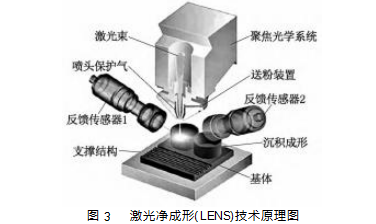
Laser Engineered Net Shaping (LENS) was developed by Sandia National Laboratories, USA, in the late 20th century, integrating the principles of LMD and SLS. This technology adopts coaxial powder feeding: a high-power laser creates a molten pool on the metal surface, and metal powder is fed into the pool to be rapidly melted and solidified, building up the formed part.
The schematic diagram of LENS is shown in Figure 3 [18]. First, a focusing optical system generates a laser beam. Then, metal powder is delivered by a powder feeder to the laser action zone, where it is locally melted and fused to form a molten pool. As the substrate gradually rises and powder is continuously supplied, the molten pool solidifies to form a 3D solid part. The whole process is carried out under the protection of nozzle shielding gas to prevent material oxidation. Feedback sensors 1 and 2 monitor key parameters in real time to achieve precise control and ensure forming quality.
1.3.1 Technical Characteristics
The remarkable advantage of LENS is that it can directly deposit and repair materials on part surfaces, with dense microstructure and good mechanical properties. LENS can process various materials and allows material placement according to part requirements during production, achieving an ideal combination of material and performance, making it highly advantageous for manufacturing heterogeneous and functionally graded metal parts. However, LENS also has defects such as part volume shrinkage and low forming accuracy caused by excessive laser power during forming.
1.3.2 Applications
LENS is widely used in aerospace, national defense, military, automotive manufacturing and other fields, especially suitable for fabricating high-strength metal parts. The technology can directly produce fully dense metal parts with little or no post-processing, greatly improving manufacturing efficiency. In addition, a prominent advantage of LENS is that it can directly repair and remanufacture existing parts, especially suitable for restoring metal parts and equipment.
As early as the Afghanistan War, the U.S. military used LENS to repair helicopter engine blades in real time [19]. In 2018, the Tinker Air Force Base Maintenance Center in the United States successfully repaired turbine blades of F-15 fighters using LENS [20]. Under the guidance of Professor Wu Dongjiang, Shi Longfei [21] conducted experimental research on metal ternary impeller blades via LENS, explored the laser engineered net shaping method for inclined thin-walled structures, and successfully realized the forming of large-angle inclined structures, providing a new idea for the rapid manufacturing and repair of such structures. Shi Wenjie et al. [22] successfully prepared 316L stainless steel specimens with porous structures via LENS. Tests showed that the LENS-formed porous specimens had fine grain structure and higher hardness, and hydroxyapatite could form on the pore surfaces, showing excellent biocompatibility. This study provides theoretical and experimental support for the application of LENS in the manufacture of medical porous materials. Geng Hailong et al. [23] discussed in detail the application of LENS in the fabrication of Ti-1300 titanium alloy. The feasibility of manufacturing titanium alloy parts via this technology was studied through heat treatment experiments, providing important theoretical and experimental basis for the preparation and application of high-strength and high-toughness titanium alloys via LENS.
2 Development Prospects of Metal 3D Printing Technology
With increasing national attention to metal 3D printing, it can be predicted that several common metal 3D printing technologies will develop rapidly with an accelerating pace of technological evolution, as reflected in the following aspects:(1) For SLM: efforts will be made to improve laser power while ensuring part quality to achieve higher forming efficiency; more composite powder materials suitable for this technology will be developed.(2) For EBM: the control accuracy of the electron beam will be improved to enhance melting efficiency and the uniformity of the part microstructure; larger printing chambers will be developed to manufacture larger-size parts.(3) For LENS: the powder feeding system will be optimized and laser beam focusing accuracy improved to increase forming accuracy and powder utilization; more advanced support structures will be developed to stabilize the forming process; more applicable powder materials will be developed.
3 Conclusions
Metal 3D printing technology is promoting the transformation and upgrading of the manufacturing industry with advantages such as large design freedom, extremely high material utilization, and rapid manufacturing of complex components. With the continuous progress of precision machining and post-treatment technologies, the reduction of technical costs and improvement of production efficiency will further broaden its application possibilities in various fields and continuously drive the manufacturing industry toward greater intelligence and customization. In the future, metal 3D printing will surely exert a far-reaching impact on the global manufacturing industry and even the service industry, opening a new chapter in new-quality productive forces
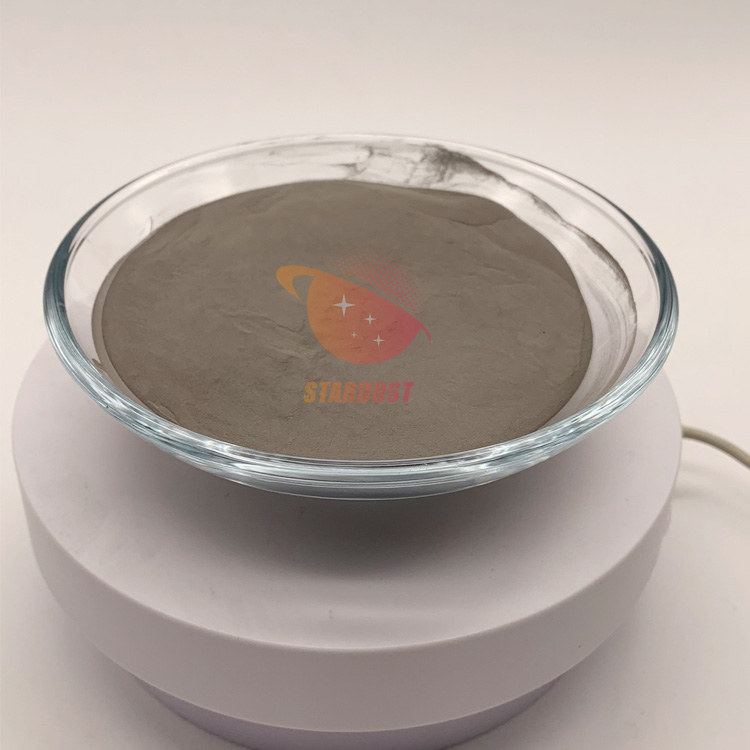
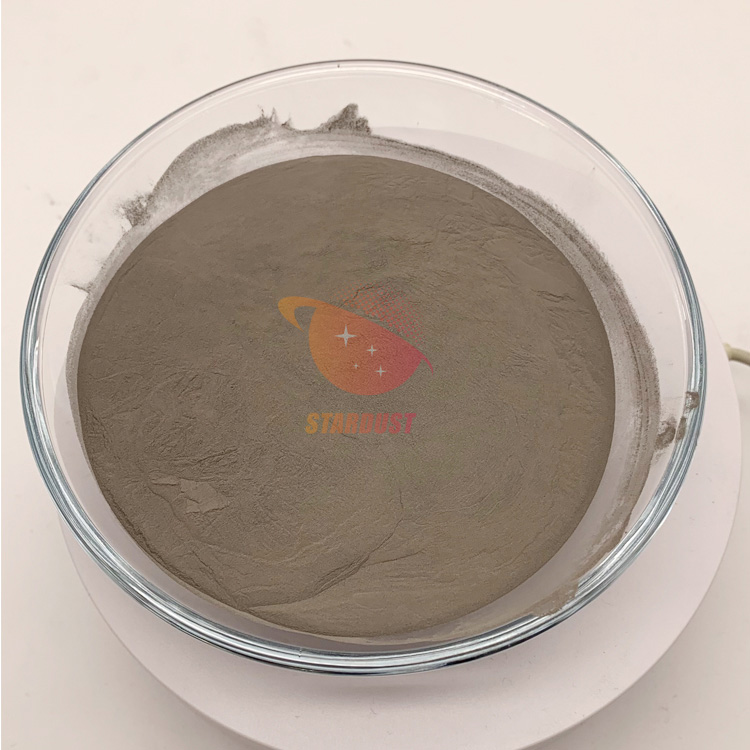
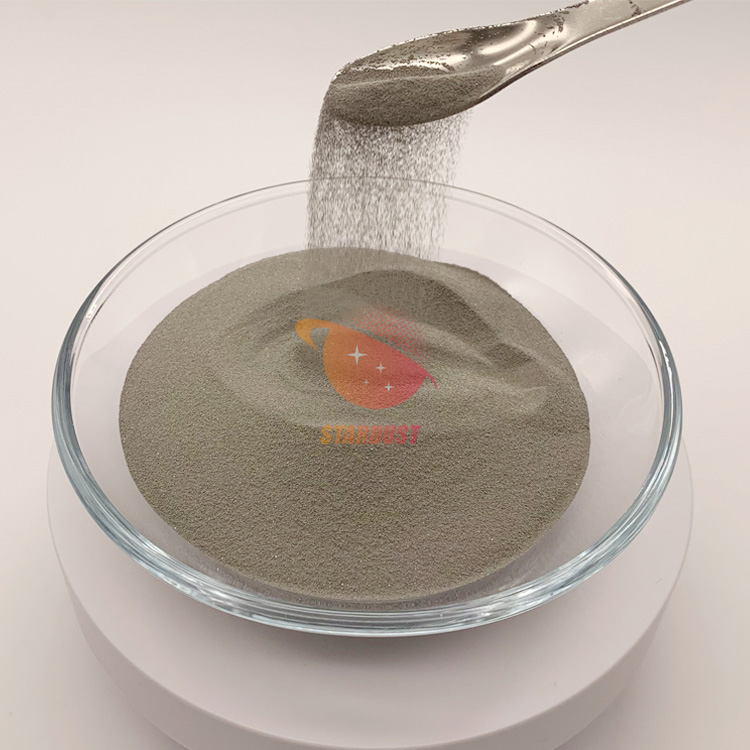
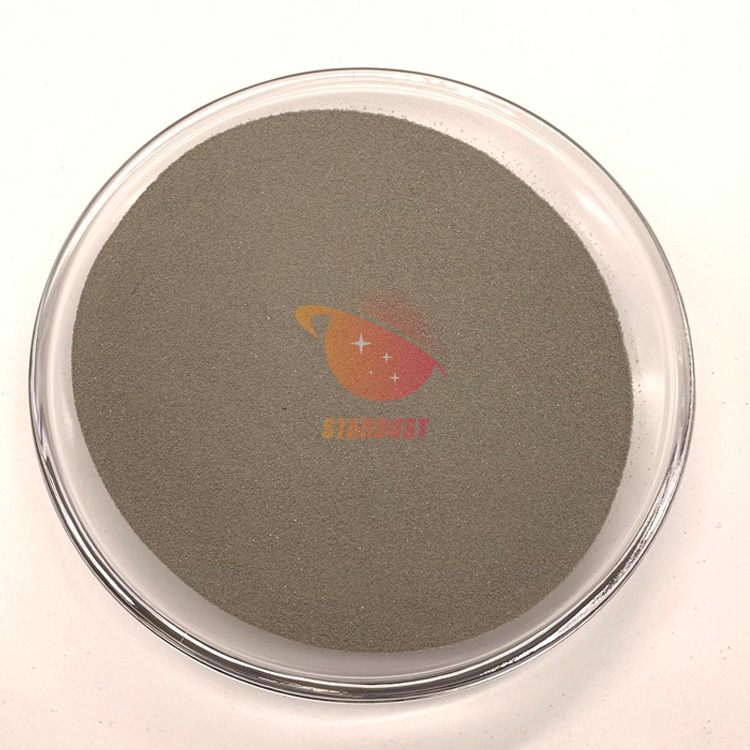
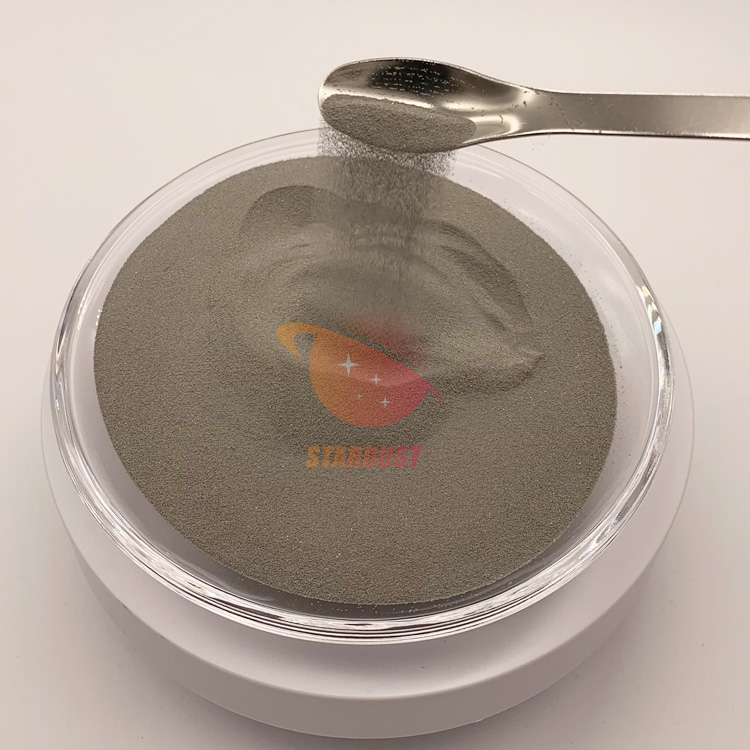
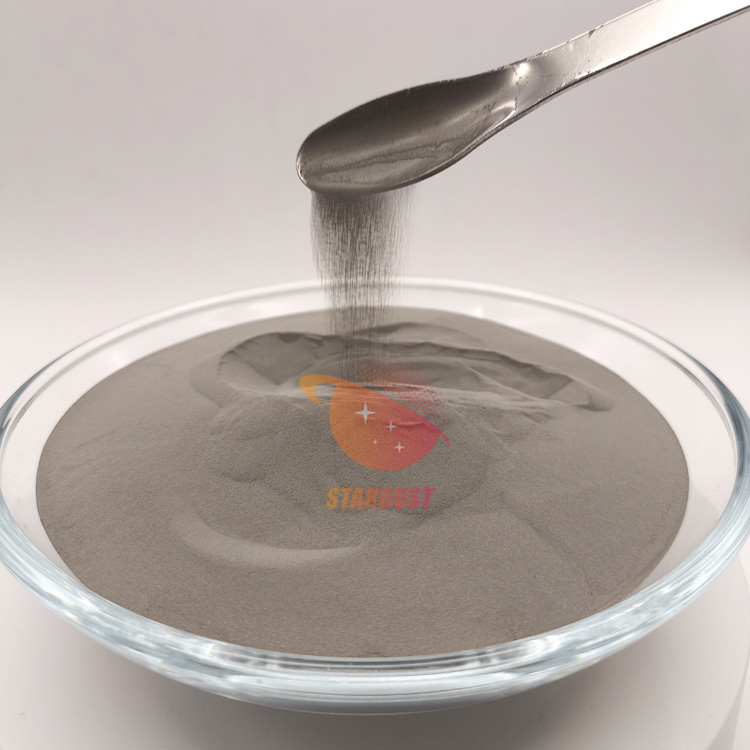
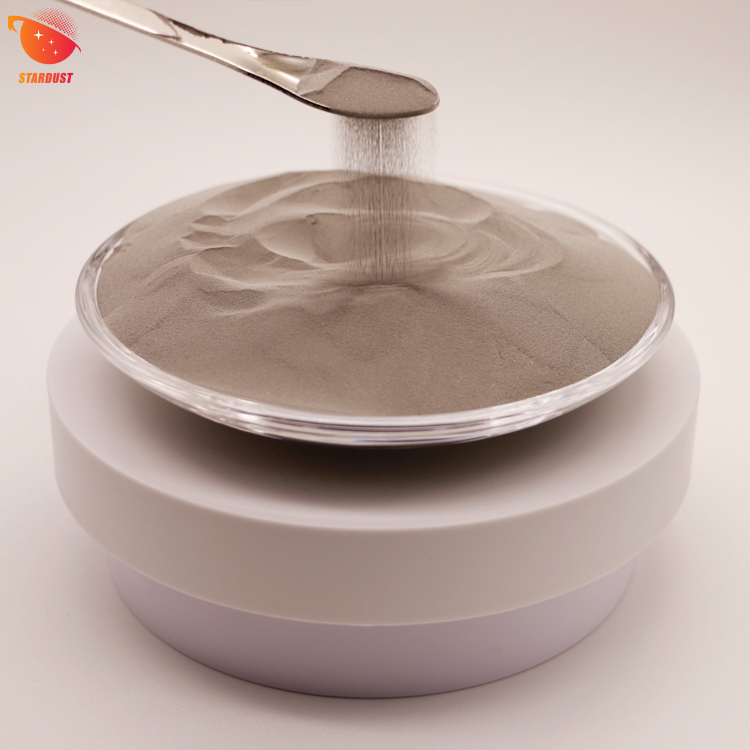
The 3D printing alloy powder produced by Stardust Technology is manufactured through precise raw material proportioning, plasma high-temperature melting, rapid solidification, and multi-stage classification, ensuring stable and controllable powder quality.The production process strictly complies with the ISO9001:2015 quality management system, which effectively reduces impurity and oxygen content, and improves powder sphericity and particle size uniformity.The powder features high purity, low oxygen content, high sphericity, smooth surface and no satellite particles. It has a concentrated particle size distribution, excellent flowability, and qualified apparent density and tap density.Benefiting from the intrinsic properties of high-entropy alloys, the powder exhibits outstanding high-temperature strength, corrosion resistance and radiation resistance, with uniform chemical composition and no segregation. It is compatible with various precision forming processes.Main applications cover extreme environments such as aerospace, national defense, military industry, and nuclear energy, suitable for high-temperature structural components and key parts for nuclear reactors. It also has promising potential in high-end equipment manufacturing, catalysis, electromagnetic shielding and other fields.Target customers include enterprises engaged in R&D of high-end refractory materials and precision forming, such as aerospace manufacturers, defense and military research institutions, nuclear energy equipment enterprises, as well as universities and research institutes.We provide customers with comprehensive technical support for powder preparation and application, and can meet customized demands for different scenarios.For more product information, please contact:Manager Duan: +86 13378621675






 IPv6 network supported