Abstract : To address the high cost issue of adding nickel to 40CrNiMo steel while maintaining its good hardenability , a technical solution was proposed to reduce nickel content through vanadium (V) microalloying , aiming to achieve cost control while maintaining excellent hardenability. The original austenite grains and microstructure of the experimental steels were characterized using scanning electron microscopy (SEM) and transmission electron microscopy (TEM) . The difference in hardenability between the developed 40CrNiMoV steel and 40CrNiMo steel was analyzed by continuous cooling transformation (CCT) curve measurement and end-quenching test , and the principle of nickel substitution was explored. The results show that V microalloying reduces the critical cooling rate for obtaining a fully martensitic structure in the 40CrNiMo steel. When the cooling rate is 10 ℃ /s , the microstructure of the 40CrNiMoV steel is fully martensite , while some bainite still exists in the 40CrNiMo steel. The improvement of hardenability by V is related to the austenitizing temperature. When the austenitizing temperature is 850 ℃ , the presence of undissolved MC type carbides and grain refinement restrict solid solution of alloy elements , resulting in limited improvement of hardenability. When the austenitizing temperature is 870 ℃ and 900 ℃ , the carbides in the microstructure of the 40CrNiMoV steel completely dissolve and the grains undergo moderate coarsening , exhibiting better hardenability. Quantitative analysis shows that when austenitized at 870 ℃ , the enhancement effect of 0. 08% V element on the ideal critical diameter (DI) is 0. 99 times that of 1. 2% Ni ( the difference in Ni content between the two steels) , demonstrating excellent improvement in hardenability.
The trend toward larger-scale equipment has placed more stringent demands on the hardenability of steel used for large-diameter bolts (64 mm ≤ φ ≤ 72 mm). After quenching, it is difficult to achieve a fully martensitic microstructure in the core of large-diameter bolts; the proportion of microstructures such as bainite increases with the increase in cross-sectional dimensions [1–3], which affects the uniformity of cross-sectional properties and low-temperature impact toughness [4–5]. Therefore, large-diameter fasteners are typically manufactured using steel grades containing certain amounts of Cr, Ni, and Mo, such as 40CrNiMo. The addition of Ni improves low-temperature impact toughness [6–8], and on the other hand, improves hardenability [7,9]. However, the inclusion of Ni makes these steels more expensive than comparable grades, failing to meet the demand for low-cost solutions. Developing a low-cost alloying strategy remains an unresolved challenge in the field of large-sized bolts.
Currently, the primary method for improving hardenability is through alloying. One approach involves the addition of trace amounts of Al and B, either individually or in combination; an Al content of approximately 0.05% by mass can significantly improve hardenability [10]. The addition of approximately 10×10⁻⁶ B can also markedly improve hardenability [10–12], although the inclusion of these elements can adversely affect low-temperature impact toughness [13]. Second, alloying elements such as Cr, Mn, and Mo are added to enhance hardenability [4,14–15]. These elements form carbides in the steel, which act as nucleation sites for the high-temperature transformation of undercooled austenite and thus hinder hardenability [16]; they also increase production costs. Recent studies have found that when V exists in a solid-soluble state, it can improve hardenability [17–18]; furthermore, the addition of V helps improve mechanical properties [19–21], and since the required amount of V is small, its impact on steel costs is minimal. Therefore, to address the quenching hardenability issues of large-sized bolts, this study developed 40CrNiMoV steel by adding a small amount of V to the 40CrNiMo steel alloy system while significantly reducing the Ni content. The study investigated the differences in continuous cooling transformation behavior and quenching hardenability between 40CrNiMoV steel and 40CrNiMo steel, and discussed the influence of vanadium’s phase state on quenching hardenability in conjunction with microstructural analysis.
1. Test Materials and Methods
The chemical compositions of the two test steels are shown in Table 1. The static continuous cooling transformations of the test steels were studied using a DIL805 thermal expansion phase analyzer. The experimental procedure was as follows: cylindrical specimens measuring 4 mm × 10 mm were heated to 870°C in the thermal expansion analyzer and held at that temperature for 8 minutes. They were then cooled to room temperature at rates of 0.05, 0.1, 0.3, 0.5, 1, 3, 5, 10, 20, and 50°C/s, respectively. Phase transformation points were determined using the tangent method on the thermal expansion curves. The microstructure of the cooled specimens was observed using an Apreo 2s scanning electron microscope (SEM); the hardness of each specimen was measured using a Leeb RH2150 Rockwell hardness tester, with a load of 150 kg applied for 3 seconds.

The differences in hardenability of the test steels were investigated using end-quenching tests. The test method followed GB/T 225—2019, “Test Method for Hardenability of Steel by End-Quenching (Jominy Test),” with three different austenitizing temperatures selected: 850, 870, and 900°C. The original austenite grains at different austenitizing temperatures were etched using a supersaturated picric acid solution, and the average grain size was subsequently determined using the intercept method. The microstructures at different austenitizing temperatures were etched using a 4% nitric acid-alcohol solution and then observed under a scanning electron microscope (SEM). A JEOL 2100 transmission electron microscope (TEM) was used to characterize the undissolved carbides in the microstructure. The samples were mechanically ground and polished, then prepared using double-spray electrolysis. The double-spray solution consisted of a 7% perchloric acid-alcohol solution, with a voltage of approximately 40 V and a controlled temperature of about -40°C.
2. Test Results and Analysis
2.1 Phase Transformation Patterns of the Test Steel During Continuous Cooling
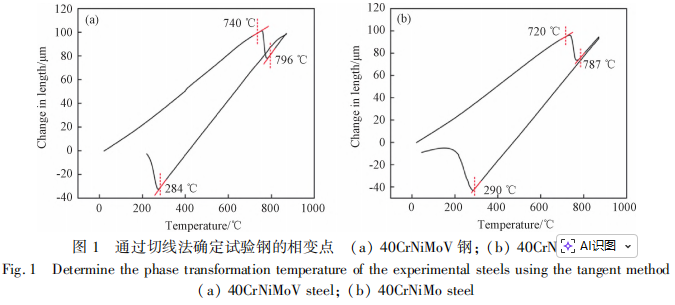
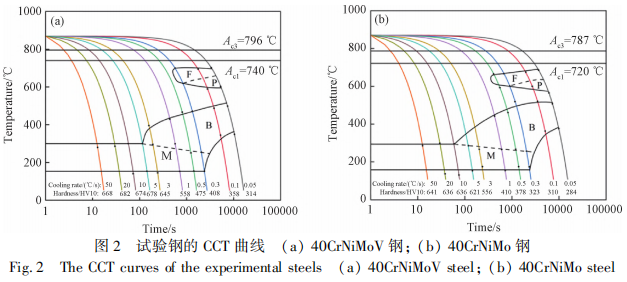
The phase transformation points of the test steels were determined using the tangent method. For 40CrNiMoV steel, Ac1 = 740°C, Ac3 = 796°C, and Ms = 284°C; for 40CrNiMo steel, Ac1 = 720°C, Ac3 = 787°C, and Ms = 290°C (Figure 1 shows the thermal expansion curve at a cooling rate of 50°C/s). Figure 2 shows the continuous cooling transformation (CCT) curves for the test steels. The pearlite transformation of 40CrNiMoV steel occurs within the cooling rate range of<0.1 °C/s, while that of 40CrNiMo steel occurs within the cooling rate range of <0.5 °C/s; The critical cooling rate for 40CrNiMoV steel to obtain a pure martensitic microstructure is 5°C/s, while that for 40CrNiMo steel is 10°C/s. Due to the higher Ni content in 40CrNiMo steel, its phase transformation temperatures are slightly lower than those of 40CrNiMoV steel [22]. The lower critical cooling rate indicates that 40CrNiMoV steel has better hardenability, and its ability to form martensite is superior to that of 40CrNiMo steel.
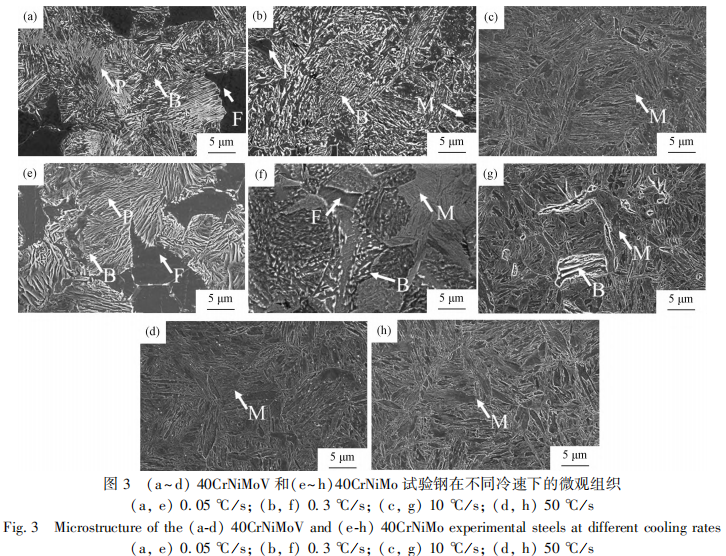
Figure 3 shows the microstructure of the test steels at different cooling rates. When the cooling rate is 0.05 °C/s, the microstructure of both test steels consists of pearlite, ferrite, and bainite; When the cooling rate was increased to 0.3 °C/s, the pearlite disappeared, and the microstructure consisted primarily of bainite and a small amount of martensite; when the cooling rate was 10 °C/s, the 40CrNiMoV steel exhibited a fully martensitic microstructure, while the 40CrNiMo steel still contained a small amount of bainite; as the cooling rate continued to increase, both test steels developed a fully martensitic microstructure.
2.2 Effect of Austenitizing Temperature on Hardenability
The hardenability curves of the test steel at different austenitizing temperatures are shown in Figure 4. When the austenitizing temperatures were 850, 870, and 900°C, respectively, the hardness of the quenched end of the 40CrNiMoV steel was 55.5, 55.5, and 56 HRC, respectively, which was higher than the 54, 54.5, and 55 HRC of the 40CrNiMo steel at the corresponding temperatures. When the distance from the quenched end face is less than 15 mm, the hardness of 40CrNiMoV steel and 40CrNiMo steel does not decrease significantly; beyond this distance, the hardness shows a rapid decline. Furthermore, as the austenitizing temperature increases, the hardness of the test steel increases, indicating that a higher austenitizing temperature contributes to improved hardenability. When the austenitizing temperature is 850°C, the end-quenching curve of 40CrNiMoV steel lies below that of 40CrNiMo steel, indicating that 40CrNiMoV steel has poorer hardenability at this temperature; When the austenitizing temperature is 870 and 900°C, the end-quenching curves of 40CrNiMoV steel are both above those of 40CrNiMo steel, indicating that 40CrNiMoV steel has better hardenability than 40CrNiMo steel. The relationship between the semi-martensitic hardness (HRC 50) of medium-carbon steel and carbon content can be calculated using Equation (1); the relationship between the ideal critical diameter (DI) and HRC 50 can be calculated using Equation (2) [23]:
HRC50=23+50·C% (1)
DI=13.395+6.109X-0.107X2+0.001X3-2.8×10-6X4 (2)
In the equation: C% represents the mass fraction of carbon; X is the semi-martensitic distance, determined from the semi-martensitic hardness on the end-quenching curve. The DI values are shown in Table 2. It can be seen that when the austenitizing temperature is 850°C, 40CrNiMo steel has a larger ideal critical diameter of 151.6 mm, whereas 40CrNiMoV steel has only 143.4 mm; When the austenitizing temperature is increased to 870°C, the ideal critical diameter of 40CrNiMoV steel reaches 166.2 mm, exceeding that of 40CrNiMo steel (133.2 mm). When the austenitizing temperature is 900°C, the ideal critical diameters of the two test steels show little change.
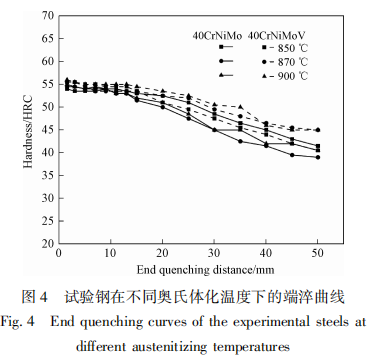
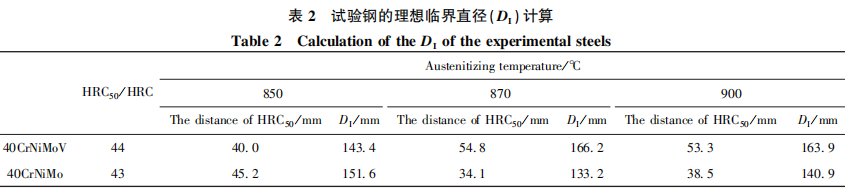
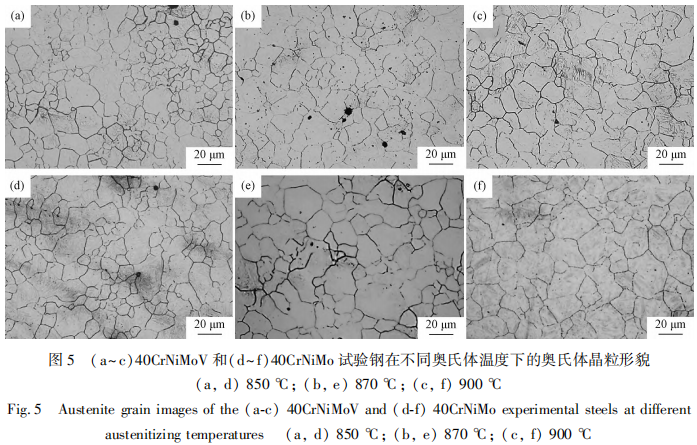
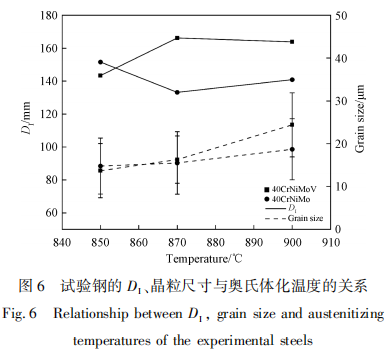
Figure 5 shows images of the original austenite grains of the two test steels at different austenitizing temperatures. The trends in grain size and ideal critical diameter (DI) as a function of austenite temperature are shown in Figure 6. When the austenitizing temperature is 850°C, the grain size of 40CrNiMoV steel is smaller than that of 40CrNiMo steel; when the austenitizing temperature is 870 and 900°C, the grain size of the 40CrNiMoV steel is larger than that of the 40CrNiMo steel. Some studies indicate that grain size is correlated with hardenability; an increase in grain size contributes to improved hardenability, generally attributed to a reduction in the proportion of grain boundaries, which decreases the number of nucleation sites for pearlite and bainite transformations [24]. Therefore, grain size and the ideal critical diameter exhibit the same variation pattern. However, the difference in grain size between the two test steels is not significant, whereas the ideal critical diameter shows a substantial difference; thus, the V element also plays an important role.
3 Discussion
3.1 Effect of V on Hardenability
As shown in Table 2, the DI of 40CrNiMoV steel at 870 and 900°C is significantly higher than that of 40CrNiMo steel. Both V and Ni elements enhance hardenability. Ni is a non-carbide-forming element that increases the nucleation energy of the α phase by lowering the martensitic transformation temperature, thereby enhancing the stability of the undercooled austenite and improving hardenability. This is reflected in the CCT curve; however, even a trace amount of V can significantly improve hardenability.
The effects of V and Ni on hardenability can be compared by calculating the expansion factor (fv) of V relative to the ideal critical diameter (DI), as shown in Equation (3) [17]:

In the equation: DI 40CrNiMoV and DI 40CrNiMo represent the ideal critical diameters of 40CrNiMoV steel and 40CrNiMo steel, respectively; CC, CCr, and CMo are coefficients introduced to account for the effects of differences in the content of C, Cr, and Mo on the ideal critical diameter, respectively [17]:
CC=fC0.40/fC0.42=0.97 (4)
CCr=fCr0.89/fCr1.00=3.00/3.25=0.92 (5)
CMo=fMo0.24/fMo0.30=1.71/1.89=0.90 (6)
When the austenitizing temperatures are 850, 870, and 900°C, respectively, the values of fv are 0.75, 0.99, and 0.93. This means that, assuming all other alloying elements remain constant, when the austenitizing temperature is 850°C, the improvement in hardenability achieved by 0.08 mass% V is equivalent to 0.75 times the difference in Ni content between the test steel and the reference steel (0.08 mass% V); Ni (the difference in Ni content between the test steels); when the austenitizing temperature is 870°C, this multiplier increases to 0.99, and further increases in austenitizing temperature result in little change in this value.
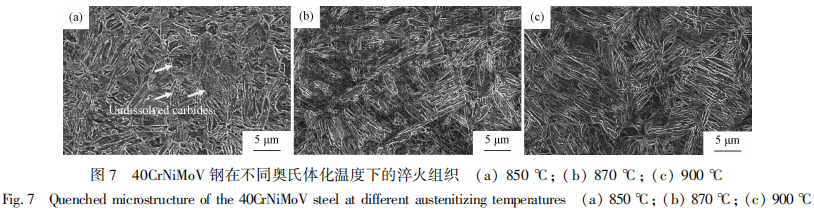
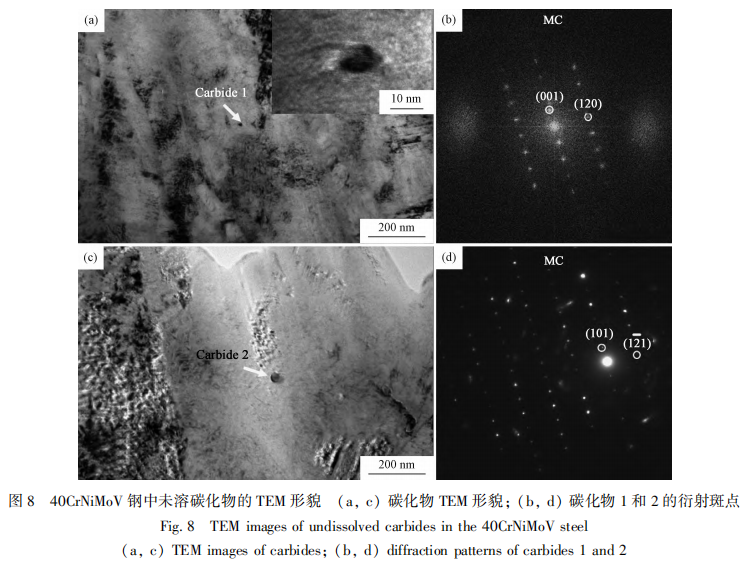
The microstructure of 40CrNiMoV steel at different austenitizing temperatures is shown in Figure 7. When the austenitizing temperature is 850°C, partial undissolved nodular carbides are present within the microstructure; whereas at austenitizing temperatures of 870°C and 900°C, all carbides within the microstructure have been completely dissolved. The morphology of the carbides was observed via TEM, as shown in Figure 8(a,c). They are spherical in shape, with dimensions in the nanoscale, and are all MC-type carbides; the diffraction patterns are shown in Figure 8(b,d). The presence of nanoscale undissolved carbides acts as grain boundary pinning, thereby inhibiting grain growth [25]; consequently, 40CrNiMoV steel exhibits a smaller grain size when the austenitizing temperature is 850°C. Furthermore, a decrease in the content of carbon in solid solution leads to a reduction in hardness [4,26].
V, in its solid-soluble state, segregates at grain boundaries and inhibits ferritic transformation through a dual mechanism: 1) It physically occupies grain boundary defects (such as vacancies and dislocations, which are preferred nucleation sites), thereby reducing the number of effective nucleation sites; simultaneously, by altering the local chemical environment and electronic structure, it increases the nucleation energy barrier, hindering the nucleation of prior-austenitic ferrite at grain boundaries; 2) It induces lattice distortion effects, regulating the migration process at phase interfaces to reduce grain boundary energy, thereby improving hardenability [27]. Therefore, the effect of V on hardenability is related to the austenitizing temperature. If the temperature is low, causing V to exist in the form of MC carbides, a low solubility concentration of V will be insufficient to improve hardenability.
3.2 Effect of V-substituted Ni on Low-Temperature Toughness
Table 3 shows the mechanical properties of the test steels, where Rm represents tensile strength, Rp0.2 represents nominal yield strength, A and Z represent elongation after fracture and reduction of area, respectively, and KV2 at -40°C represents the impact energy absorption at -40°C. Both steels were quenched at 870°C; the tempering temperature for 40CrNiMoV steel was 620°C; while the tempering temperature for 40CrNiMo was 520°C. It can be seen that when both steels have a strength grade of approximately 1200 MPa, their impact energy absorption at -40°C is also relatively close, indicating that the loss of low-temperature toughness after adding Ni in the V series is minimal.

4. Conclusions
1) At a cooling rate of 10 °C/s, the microstructure of 40CrNiMoV steel is entirely martensitic, whereas 40CrNiMo steel still contains some bainite. The addition of V lowers the critical cooling rate for hardenability in Cr-Ni-Mo bolt steels, expands the martensitic phase region, and is more effective than Ni;
2) The end-quenching curves indicate that, due to the addition of V, 40CrNiMoV steel exhibits better hardenability under low-Ni conditions, outperforming 40CrNiMo steel;
3) The austenitizing temperature has a significant effect on V’s ability to improve hardenability; as the austenitizing temperature increases, the hardenability of 40CrNiMoV steel gradually increases, and the ideal critical diameter continues to grow. This is due, on the one hand, to an increase in grain size, and on the other hand, to higher solute concentrations of C and V. The improvement in ideal critical diameter achieved by 0.08 mass% V can reach up to 0.99 times that of 1.2 mass% Ni (the difference in Ni content between the test steels).
References: Journal of Materials Heat Treatment, Vol. 47, No. 3, March 2026; Effect of vanadium on hardenability of 40CrNiMo steel; Li Xiang, Lu Hengchang, Shi Wen, Zhang Bo, Jia Laihui, Xie Li, Dong Han
As the high-end manufacturing industry continues to upgrade steadily, key materials technologies serve as a vital pillar for the sector’s development. Stardust Technology specializes in rare and refractory metal powders. Leveraging its robust technical expertise and comprehensive industrial chain, the company is committed to becoming a world-leading supplier of high-end powders. By applying practical technologies to solve industry challenges, it aims to facilitate the localization of materials in sectors such as aerospace and biomedicine. The company possesses a professional R&D team and formal certifications, with core patents covering key processes such as powder separation and 3D printing manufacturing. These technologies are highly practical and deliver excellent implementation results. As the lead organization for industry standards, Stardust Technology has spearheaded the development of multiple national standards for niobium, molybdenum, tungsten, and tantalum used in additive manufacturing, filling gaps in the domestic industry and laying a solid foundation for standardized industry development and the long-term operations of enterprises. Radio-frequency plasma spheronization technology is Stardust Technology’s core technology. Compared to traditional powder production processes, this technology utilizes ultra-high-temperature plasma to melt irregular raw powder materials, followed by cooling treatment, to achieve spheronization, densification, and alloying of the powder. This addresses industry challenges associated with traditional powder production, such as low sphericity, insufficient purity, and difficulty in controlling particle size. The spherical powders of rare refractory metals—such as tungsten, molybdenum, tantalum, and niobium—produced using this technology feature high sphericity, minimal internal defects, and controllable particle sizes. With a wide range of compatible raw materials and excellent cost-effectiveness, these powders meet the high-end manufacturing demands across various sectors. Stardust Technology not only provides powder products but has also developed three core solutions—equipment, powders, and services—to establish comprehensive industry-chain service capabilities. We offer customers integrated, customized services encompassing powder processing equipment, powder R&D, and printing validation. Through practical application cases, the company demonstrates the practical value of its technology and products, fully advancing the industrial application of rare refractory metal materials and providing reliable, critical material support for the high-end manufacturing sector. For more product information, please contact our professional sales manager, Mr. Duan, at 13378621675.






 IPv6 network supported