Abstract: To address the issue of heat distribution during the 3D printing of titanium alloy wire, this paper proposes a synergistic optimization mechanism for Joule heating and melting heat. Based on an ANSYS transient thermodynamic model, the study systematically analyzes the evolution of temperature fields under different laser powers (1–10 kW) and their effects on the corresponding stress-strain fields. The results indicate that the preheating temperature (1638 °C) and the ratio of preheating to melting heat are the core parameters for controlling build quality. When the laser power is 3 kW (preheating/melting heat ratio ≈ 1:1), the titanium alloy wire reaches the ideal melting temperature (1638 °C), and the comprehensive performance of the built part is optimized. This ratio significantly reduces the heat accumulation effect, resulting in uniform residual stress distribution and minimal deformation (total deformation of 5.75 × 10⁻⁵ mm), thereby providing a theoretical basis for high-precision titanium alloy additive manufacturing.
0 Introduction
Due to its unique advantages in the fabrication of complex components, additive manufacturing of titanium alloys has become a key manufacturing process in fields such as aerospace and biomedicine [1–2]. Unlike traditional subtractive manufacturing, this technology achieves near-net-shape fabrication through the layer-by-layer melting and deposition of titanium alloy wire, in which the distribution of Joule heat directly affects the stability of the melt pool and the quality of the fabricated parts [3].
Current research faces core challenges: insufficient preheating leads to weakened interlayer bonding (porosity > 5%), reducing mechanical properties [4]; excessive heat accumulation causes carbonization and burn damage (at temperatures > 1,700 °C, burn depth fluctuates by ±18%) [5], affecting dimensional accuracy; the mechanism of heat dissipation under vacuum conditions remains unclear, exacerbating residual stress accumulation (maximum equivalent stress reaching 4.02 × 10⁸ Pa) [6]. To address these issues, this paper proposes an optimization method based on the synergistic regulation of Joule heat: establishing a transient thermo-mechanical coupling model (ANSYS platform) to quantify the dynamic distribution relationship between the preheating temperature field (reference value 1,638 °C) and the heat of fusion under vacuum conditions; designing multi-parameter comparative experiments (laser power 1–10 kW) to reveal the mechanisms by which these parameters influence sintering depth, deformation, and stress; using a substrate size of 10 mm × 10 mm × 3 mm and wire cross-section of 2 mm × 2 mm × 0.03 mm, and employing hybrid meshing technology (0.025 mm hexahedral mesh in the scan area and adaptive mesh in the non-scan area) to balance computational efficiency and accuracy [7–9] . This study provides theoretical support for high-precision additive manufacturing of titanium alloy wires and holds significant engineering value for addressing heat-induced defects and enhancing the service performance of fabricated parts.
1 Finite Element Analysis of the Temperature Field
1.1 Model Development
The substrate is a rectangular prism measuring 10 mm × 10 mm × 3 mm (the gray section at the bottom). The filament-printed model consists of 100 cubes, each measuring 1 mm × 1 mm × 1 mm, fused and connected together, forming a total of 10 layers [10–12]. A three-dimensional coordinate system O(0,0,0) is established at the center of one edge of the substrate, with the midpoint of one side of the cube located at the origin, forming a single-track, multi-layer geometric model, as shown in Figure 1.
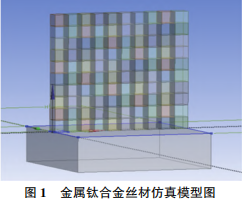
Figure 1: Simulation model of titanium alloy wire
1.2 Temperature Distribution in 3D Printing
After the first layer of 3D printing is completed, the region of highest temperature gradually shifts toward the center of the specimen. This is because heat dissipation within the specimen is difficult during the printing process. As the print height increases, heat gradually transfers to the lower part of the specimen, causing the area enclosed by a given isothermal line to expand, and the heat-affected zone to gradually increase. This occurs because, with each successive layer, the heat from the previous layer is transferred to the current layer, leading to continuous heat accumulation and an expanding heat-affected zone.
As shown in Figure 2, under these conditions, the laser power is set to the maximum level specified for the experiment (10 kW), and the proportion of melting heat in the heat distribution is higher (1:2). The printing temperature rapidly climbs to a high peak of 3,200°C within the first few seconds, and each layer of printing corresponds to a distinct temperature peak. Due to the high power input and the heat distribution pattern dominated by melting heat, the thermal accumulation effect is extremely significant. As the number of printed layers increases, the melting heat continuously accumulates, causing the temperature to rise steadily and remain at a high level throughout the process. In the later stages, the temperature approaches the critical range for titanium alloy burn-through, resulting in poor thermal stability.
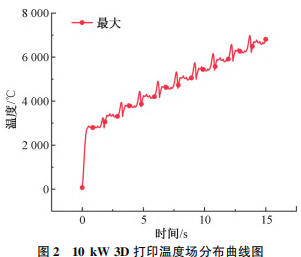
Figure 2: Temperature distribution curve for a 10 kW 3D printer
As shown in Figure 3, when the laser power is reduced to 7 kW and the ratio of preheating to melting heat distribution is adjusted to 2:3, the proportion of heat contributed by preheating increases compared to the 10 kW operating condition. The temperature still rises rapidly to 3,200°C within the first few seconds, and the characteristic temperature peak at the start of each layer remains distinct. However, due to the reduced power and optimized preheating ratio, the subsequent temperature increase caused by each layer is more gradual compared to the 10 kW operating condition. The rate of heat accumulation has slowed, and the temperature shows a steady overall upward trend without any sudden spikes.
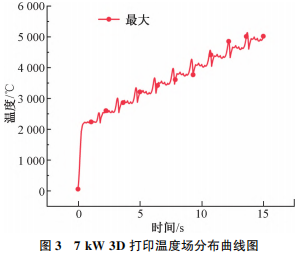
Figure 3: Temperature distribution curve for a 7 kW 3D printer
As shown in Figure 4, when the laser power was further reduced to 5 kW and the ratio of preheating to melting heat was optimized to 3:4, the preheating effect was further enhanced. The printing temperature reached 3,200°C after approximately 10 seconds. However, as the number of printed layers increased, the cumulative effect of melting heat was effectively mitigated due to the lower power input and higher proportion of preheating. Consequently, the increase in the temperature peak became significantly smaller, the range of temperature field fluctuations narrowed, and overall thermal stability was superior to that under high-power conditions (10 kW, 7 kW), with heat accumulation being preliminarily controlled.
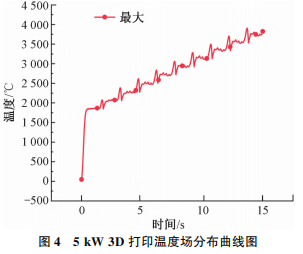
Figure 4: Temperature distribution curve for a 5 kW 3D printer
As shown in Figure 5, with a laser power of 3 kW, a balanced state was achieved where the ratio of preheating to melting heat distribution reached 1:1. After the temperature rapidly rose to 1,500°C within the first few seconds, the temperature superposition effect during subsequent layer printing was moderate due to the good match between heat input and heat diffusion efficiency. The overall temperature field exhibited minimal fluctuations, and no significant trend of sharp temperature increases was observed. Throughout the process, the temperature fluctuated around the ideal printing temperature range for titanium alloys (approximately 1,638°C), resulting in the weakest heat accumulation effect and the most stable temperature field.
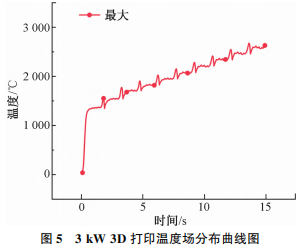
Figure 5: Temperature distribution curve for a 3kW 3D printer
As shown in Figure 6, with the laser power set to the minimum value for the experiment (1 kW) and preheating dominating the heat distribution (2:1), the heat input for melting was relatively insufficient. The printing temperature rose to 1,300°C at approximately 15 seconds, but subsequently, as the number of printed layers increased, the combination of low power and a high proportion of preheating resulted in insufficient melting heat input. Consequently, the rate of temperature increase slowed significantly, and the temperature even began to plateau. The overall temperature level was lower than under other power conditions, and the heat accumulation effect was the weakest. Due to the insufficient melting heat, it was difficult to maintain a stable temperature within the ideal melting range for titanium alloys.
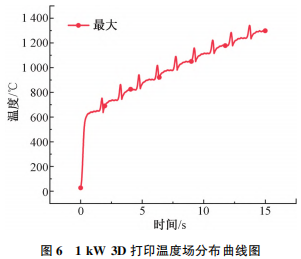
Figure 6: Temperature distribution curve for a 1 kW 3D printer
It can be seen that the temperature increases with each printed layer until the print is complete. During the printing process, the average printing temperature varies due to differences in melting heat. The printing temperature closest to that of titanium alloy is approximately 1,600°C. The best print quality is achieved when the ratio of melting heat to preheating temperature is 1:1.
2. Strain Field Analysis
ANSYS simulations can generate stress field distribution maps for titanium alloys at high temperatures, reflecting the stress state of the material under specific operating conditions. During the 3D printing process, titanium alloy materials are susceptible to thermal stress. In the SLM printing process, because the laser prints layer by layer, the residual stress distribution across layers is uneven. Figures 7–9 show the stress variation diagrams.
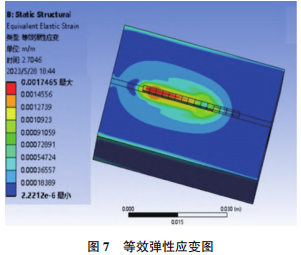
Figure 7: Equivalent elastic strain diagram
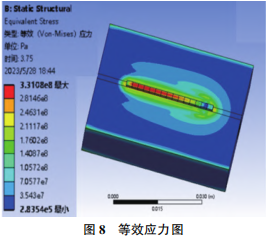
Figure 8: Equivalent stress diagram
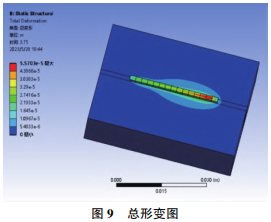
Figure 9: Total deformation diagram
In addition to stress contour plots, ANSYS thermal stress simulation analysis of titanium alloys also provides strain-stress curves at high temperatures, as shown in Figure 10. This plot provides a more accurate representation of the stress-strain conditions at a given moment, allowing for a better understanding of the deformation of the printed part.
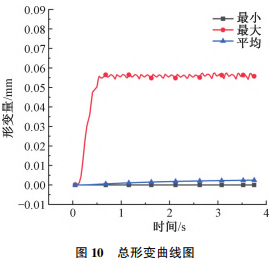
Figure 10: Total deformation curve
The equivalent elastic strain curve shown in Figure 11 provides a clear quantitative basis for optimizing the 3D printing process: the maximum strain in the curve typically occurs at the instant the laser scans the center of the melt pool; if this strain persists beyond the material’s critical threshold, it indicates a risk of overheating, which can easily lead to microcracks. In such cases, the laser power should be reduced or the scanning speed increased; The minimum strain reflects the elastic recovery state after interlayer cooling. If this value is too high, it indicates insufficient cooling, requiring an extension of the interlayer time or enhanced heat dissipation; the average strain, meanwhile, characterizes the thermal stress level throughout the entire process. By preheating the substrate or adopting a zoned scanning strategy, this can be stabilized at a lower range, thereby suppressing warpage and improving dimensional consistency. The entire curve essentially forms a “strain-process” closed-loop: by monitoring strain characteristics in real time and adjusting heat input and cooling rates accordingly, it is possible to transition from passive forming to active control. This has significant implications for high-precision metal additive manufacturing in fields such as aerospace.
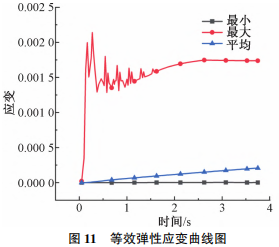
Figure 11: Equivalent elastic strain curve
Generally speaking, as temperature increases, a material’s capacity for plastic deformation increases, leading to a decrease in its fracture strength and, consequently, a reduction in the equivalent stress. Furthermore, changes in the material’s internal structure at high temperatures can also affect its strength and durability, thereby influencing the equivalent stress, as shown in Figure 12.
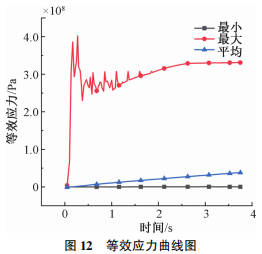
Figure 12: Equivalent stress-strain curve
When the ratio of preheating to melting heat distribution is 1:1, the equivalent elastic strain of the printed part is 2.14 × 10⁻³, the equivalent stress is 4.0197 × 10⁸ Pa, and the total deformation is 0.05746 mm. It can be observed that the total deformation of the titanium alloy increases as the temperature rises. This is because the material’s coefficient of thermal expansion increases with temperature, causing the dimensions of the printed part to expand. Heat accumulation within the printed part also causes internal stress changes, further leading to material deformation. Therefore, selecting an appropriate laser power and incorporating a cooling period will result in a higher-quality printed part.
3. Conclusions
This paper establishes a model for the distribution of Joule heating and melting heat during the additive manufacturing of titanium alloy wire in a vacuum environment, and systematically investigates the effect of the heat distribution ratio on the quality of the formed parts. The main conclusions are as follows:
(1) During the printing process, the average printing temperature varies due to differences in melting heat. The printing temperature closest to that of metallic titanium alloy is approximately 1,600°C. The best print quality is achieved when the ratio of melting heat to preheating heat is 1:1.
(2) When the preheating-to-melting heat distribution ratio is 1:1, the equivalent elastic strain of the printed part is 2.14 × 10⁻³, the equivalent stress is 4.0197 × 10⁸ Pa, and the total deformation is 0.05746 mm.
(3) This study confirms that the synergistic control of Joule heat and preheating allocation is a key approach to improving the print quality of vacuum-treated titanium alloys, providing theoretical support for the manufacturing of high-precision aerospace components.
References: Welding Technology, Vol. 55, No. 2, Feb. 2026; Analysis of Joule Heating Preheating and Melting Heat Distribution in 3D Printing of Titanium Alloy Wire; Zhang Weibo; Liu Wei; Wang Jianghan; Li Suli
Analysis of Joule Heating and Melt Distribution in 3D Printing of Titanium Alloy Wire Materials, by Zhang Weibo, Liu Wei, Wang Jianghan, and Li Suli. As the advanced manufacturing and new materials industries accelerate their transformation, high-end spherical powders made from rare and refractory metals, along with customized additive manufacturing services, have become the core pillars for overcoming technical bottlenecks in key sectors. As a National High-Tech Enterprise, Stardust Technology specializes in the R&D of RF plasma spheronization technology, the production of high-end spherical powders made from rare and refractory metals, and end-to-end technical services for additive manufacturing. Leveraging its solid technical expertise and strategic industrial chain layout, the company has steadily established itself as a reliable solution partner in the industry. Technology is the cornerstone of corporate development. Stardust Technology draws deeply on the R&D team at the Institute of New Materials of the Guangdong Academy of Sciences, leveraging over three decades of accumulated expertise in materials research and process development to firmly master the core technology of RF plasma spheronization for powder production. Optimized for the characteristics of rare refractory metals, this technology efficiently produces specialized powders with high purity, high sphericity, and excellent flowability, meeting the stringent requirements for high-quality materials in fields such as aerospace, high-end equipment, and precision manufacturing. Unlike single-product or service models, Stardust Technology focuses on customers’ end-to-end needs, creating an integrated “high-end equipment + spherical powders + 3D printing” solution that breaks down barriers across the industrial supply chain. Currently, the company has established a full-industry-chain layout integrating R&D of powder production equipment, powder preparation, material modification, and 3D printing services. This enables a closed-loop service spanning equipment supply, material customization, and forming processing, eliminating the need for clients to coordinate with multiple parties and enhancing project implementation efficiency and the stability of finished product quality. Adhering to a commitment to craftsmanship and deepening expertise in niche markets, Stardust Technology, with technological innovation at its core and supported by its full-industry-chain advantages, continues to specialize in the fields of high-end powders and additive manufacturing. The company helps the advanced manufacturing industry improve quality and efficiency while driving iterative upgrades, injecting sustained momentum into the localization of high-end materials and the high-quality development of the industry. For more product information, please contact our professional sales manager,Cathie Zheng, at +86 13318326187.






 IPv6 network supported